ATEX APPROVED STAINLESS STEEL 316L

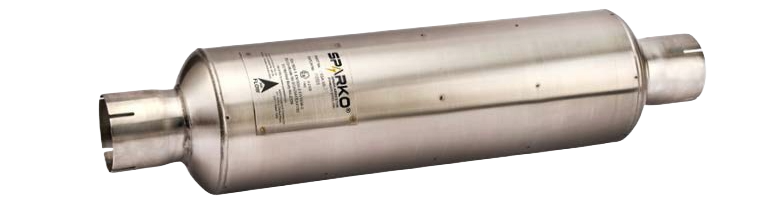
Diesel engine exhaust SPARKO Stainless Steel Spark Arrestors are designed as a safety device specifically for preventing the sparks emitting from diesel engines. The quenching type design, that works on the principle of breaking down the glowing particles emitting from the diesel engine exhaust by repeatedly impacting against the internal baffles and quenching hot particles through centrifugal action. This cools and breaks them down before safely discharging to the atmosphere.

Overview

The SPARKO spark arrestor is constructed of stainless steel 316L corrosion resistant material containing a spinning device and baffles that is securely incorporated into tubular structure. It contains no moving parts and requires little maintenance.

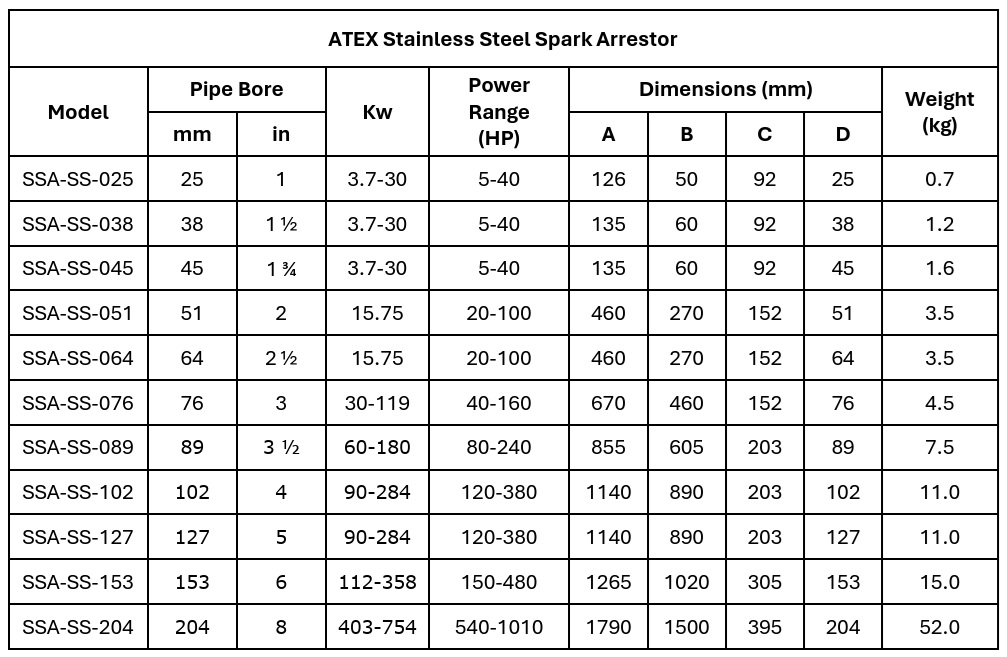
Spark arrestors are intended for use with diesel engines only. SPARKO spark arrestors should be sized to suit the engine; this can be done based on exhaust pipe size or Horse power (HP/KW) of the engine.

SSA SPARKO Spark Arrestors are intended for use with diesel engines only and have been independently tested and assessed to the requirements of EU Directive 2014/34/EU – Equipment intended for use in potentially explosive atmosphere (ATEX).
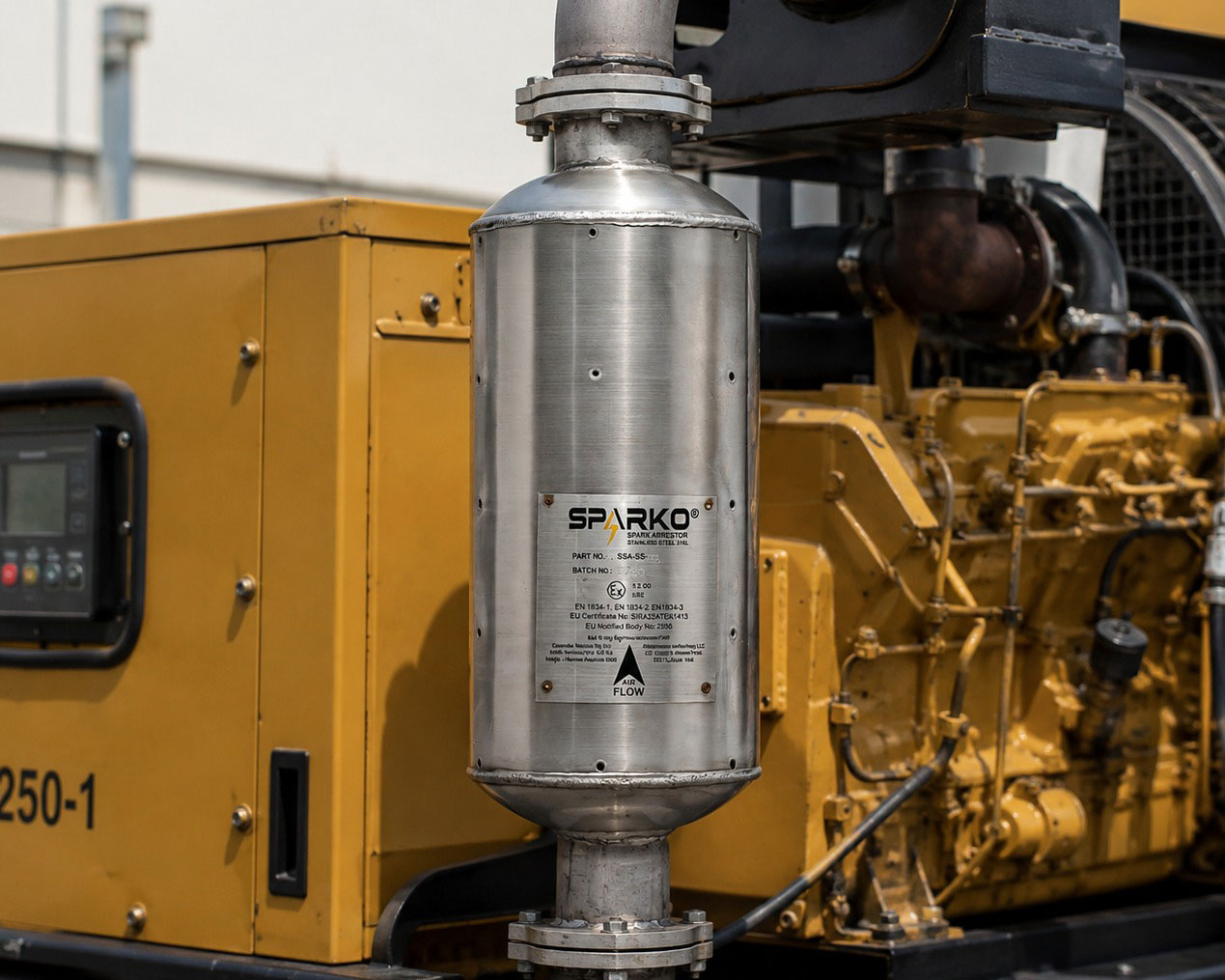
Applications

Forklift Trucks in hazardous areas

Offshore platforms

Diesel engine exhaust

Refinery vehicles & equipment

Drilling rigs

Features

Sparko spark arrestor are safe to use in potentially explosive atmospheres.

Constructed from stainless steel 316L grade for corrosion resistance and longevity.

Wide range available up to 1006hp (750kw).

Improved internal gas flow dynamics.

Meets engine manufacturers published back pressure specification providing emission conformance, and exceptional spark-arresting abilities.
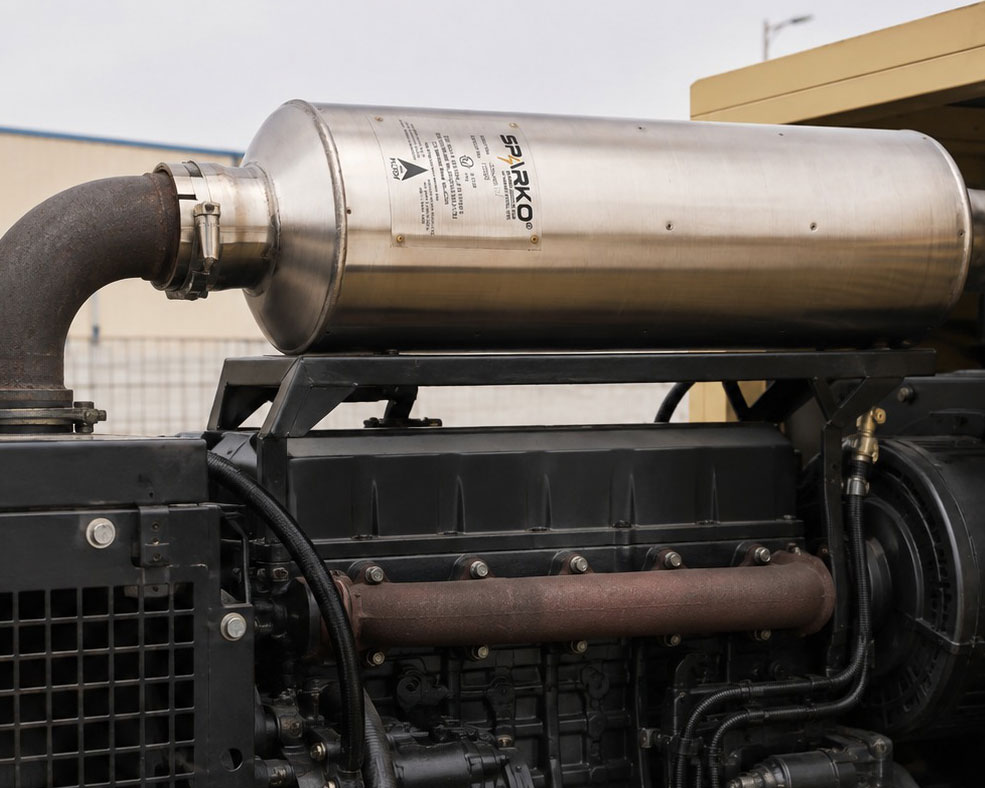
Tested and Approved

Sparko spark arrestor are ATEX certified with the following exceptions:

  • The spark arrestor types have been tested and comply with the spark arrestor performance requirements for diesel engine exhaust spark arrestor, intended for use in zone 1 & zone 2 hazardous areas as defined by the ATEX Directive.
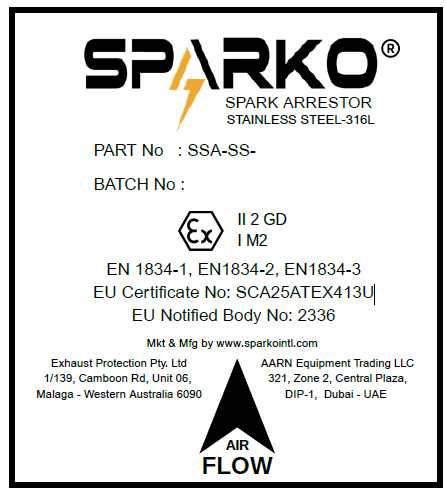
  • ATEX EU Notified body no. 2336
  • ISO 9001:2015 | ISO 14001:2015
  • The ATEX type are marked
  • II 2 GD I M2

  • In accordance with the following standards, EN 1834-1, EN1834-2, EN1834-3
  • Range and Selection

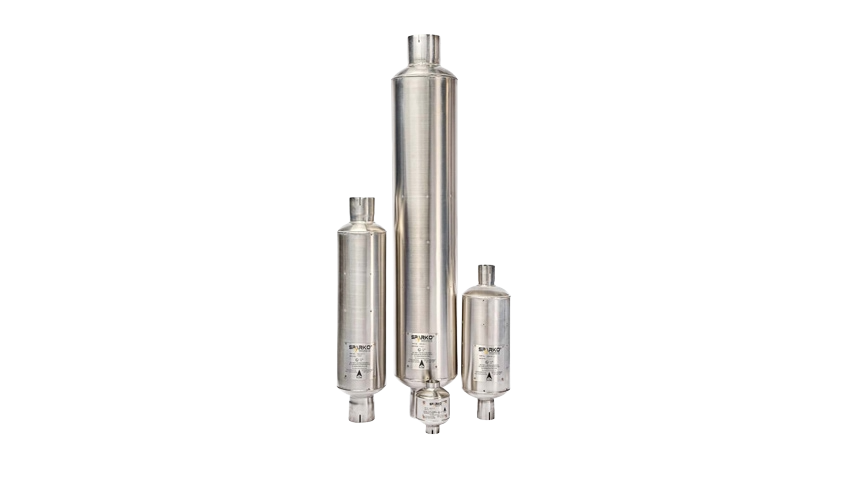
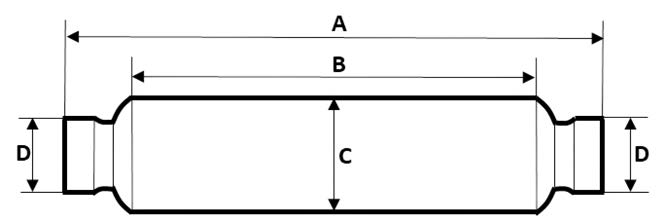
    Sparko has a comprehensive range of ATEX spark arrestors suitable for a wide range of applications. Spark arrestors with different variety of lengths, diameters, pipe sizes and power ranges, allowing you to find the spark arrestor which meets your specification.
    Mounting Instruction

  • Refer to product plate for type and see the data sheet to ensure suitability of the spark arrestor for engine exhaust size and power.
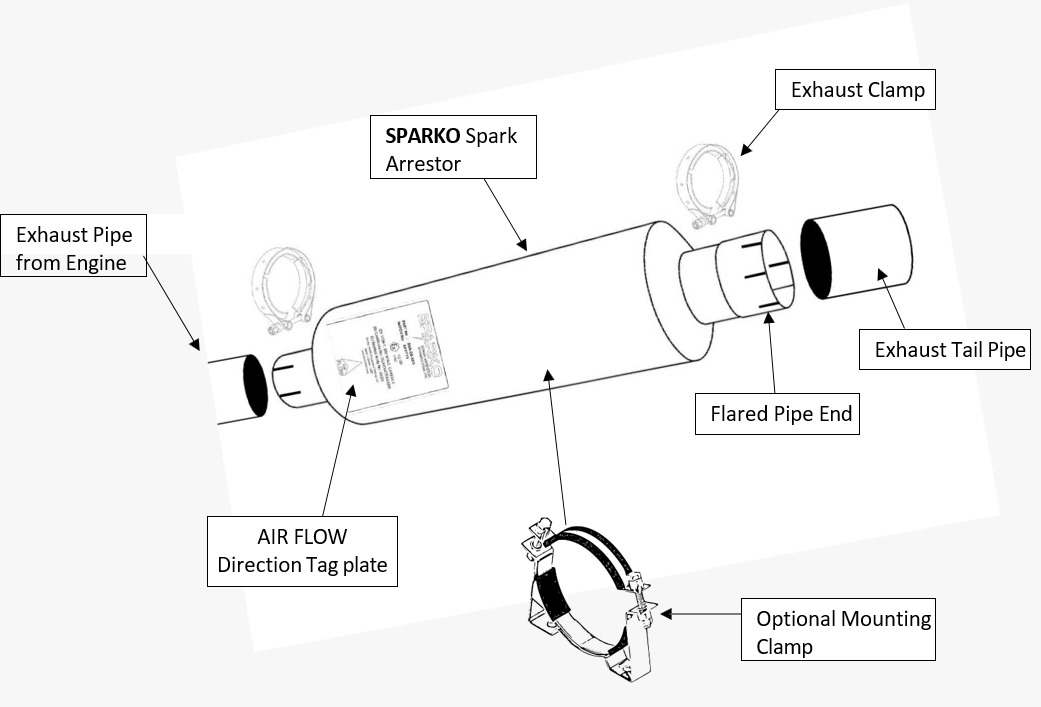
  • Ensure that the Spark Arrestor is installed with flow arrow in the direction of the gas flow.
  • The spark arrestor can be mounted vertically or horizontally as long as they are supported adequately
  • Fit the Spark Arrestor on the exhaust pipe at the tail end, after any other devices such as Mufflers or silencers. Attention should be paid to the safe positioning of the tail pipe.
  • If the surface temperature causes a hazard, position it in a way that it does not come in contact with any human, you may use a protection guard.
  • Ensure the exhaust system is in good condition and all the joints are gas tight with no leaks.
  • Adequate support with extra brackets may be required. The SPARKO spark arrestor is supplied with U bolt or circular band type clamp.
  • Maintenance

  • The SPARKO stainless steel spark arrestors contain no serviceable parts and require minimal maintenance.
  • Examine the spark arrestor and exhaust system daily for any damage, cracks, dents or corrosion.
  • The spark arrestor is self-cleaning in normal conditions. However, after prolonged use, if the engine spends a longtime idling, or is sooty; the unit may be cleaned, in a safe area. By bringing the engine to operating temperature, then running at high revs, the spark arrestor case should be lightly tapped to blow out any accumulated carbon particles from the exhaust.
  • After every 750 hours of operation or 3 months of use, we recommend removing the spark arrestor for inspection. Check for any signs of damage and lightly tap the casing to dislodge and remove accumulated soot deposits. Also, inspect for any loose or damaged internal baffles.
  • The spark arrestor may be thoroughly cleaned using water, a mild detergent, or a non flammable degreaser. Once cleaned, reinstall the unit and perform a spark arrestor check as previously described.
  • If excessive soot deposits are observed, the engine should be inspected before returning the equipment to service.
  • Any damaged or defective Spark Arrestor must be replaced before operating in a hazardous area.
  • Tag plate